Which size is right for your space?
- Living room (above sofa): 48x32 for visual balance
- Bedroom (above headboard): 36x24 or 48x32
- Dining room: 36x24 or 48x32, depending on wall size
- Home office or den: 30x20 or 36x24
- Large foyer or entryway: 48x32—go bold where first impressions matter
- Hallway, bathroom, or gallery wall: 18x12 or 24x16
When in doubt, go bigger than you think—undersized art is the most common mistake. The print should fill about ⅔ the width of the furniture beneath it.
Want to see it on your wall before you order? Use the Live Preview AR button on any print to view it in your actual space using your phone or tablet camera.
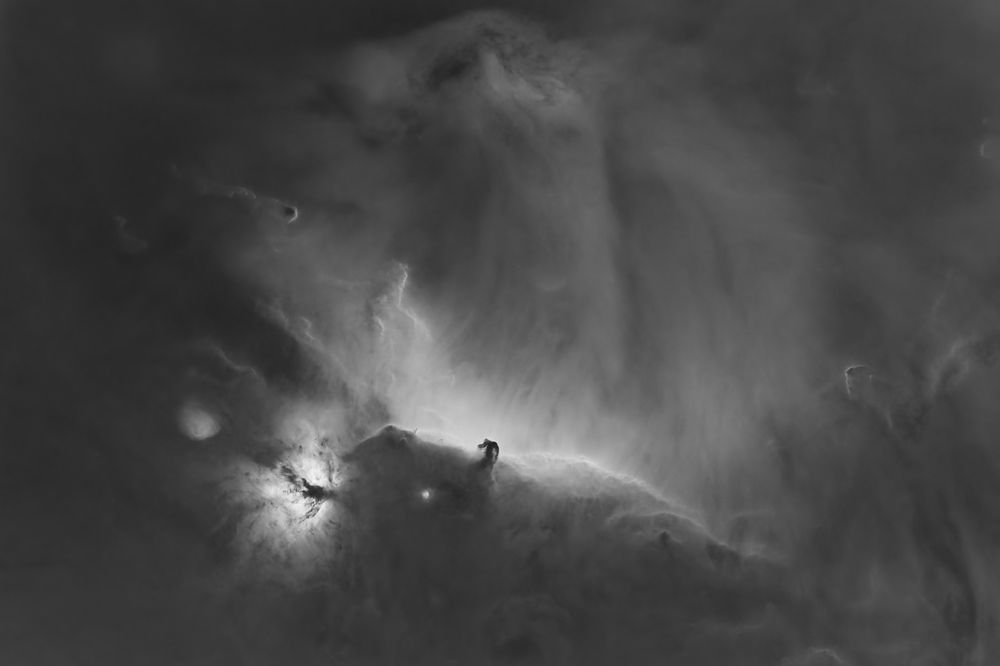
The Horsehead Nebula (B33, IC 434) is a famous dark nebula in the constellation Orion. It is part of the Orion Molecular Cloud Complex, one of the nearest active regions of star formation to the Sun. It can be located near the bottom star of the "belt of Orion," the three main stars that form Orion's Belt. The nebula lies at an approximate distance of 1,375 light-years from the solar system.
The Horsehead Nebula is one of the most identifiable nebulae in the sky. It appears in the southern portion of a dense dark dust cloud cataloged as Lynds 1630 (LND 1630).
The swirling clouds of gas and dark dust that form the nebula have the shape of a horse’s head, giving the nebula its name. The dark dust clouds are made visible by the pinkish glow of hydrogen gas located behind the nebula.
The Horsehead Nebula's darkness stands out against the emission nebulosity in the background. The nearby bright star Sigma Orionis partly illuminates the Horsehead by causing the glow of the ionized hydrogen gas behind the nebula.
This is a starless image of the Horsehead Nebula taken only with Hα emissions (see below for more explanation), creating an incredible black-and-white image of this famous region of space.
This photograph was stacked with 120 Hα images taken over 3 nights from my bortle 8 urban skies here in my backyard in Phoenix, Arizona.
NOTE:
The majority of photographs of nebulae are in a false color palette. False-color photographs of nebulae are essentially color (RGB) photographs whose color channels have been mapped to specific emission lines. In these images, each color can represent a specific element. In other words, a false-color image of a nebula tells us exactly what it’s made of. There are many emission lines, but the three most photographed by astronomers are hydrogen-alpha, oxygen-III and sulfur-II. These emission lines are captured by using narrowband filters, which only let through the light at very specific wavelengths; typically, most of my photographs are taken with filters allowing a bandwidth of 3µm.
|
Element
|
Emission line
|
Wavelength
|
Color
|
|
Hydrogen
|
Hα
|
656.3 nm
|
Red
|
|
Oxygen
|
O-III
|
500.7 nm
|
Blue/Green
|
|
Sulfur
|
S-II
|
672.4 nm
|
Red
|
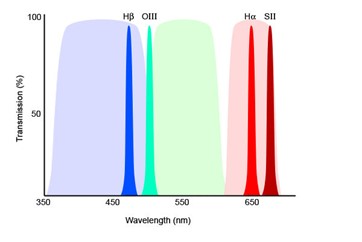
Mapping Hα, O-III and S-II to red, green and blue is problematic when two of them are red, one is blue/green, and none is pure blue. Astronomers deal with this by using false color — one or more of these elements is going to have to take a hit for the team and take on an unnatural hue. The Hubble palette assigns red to S-II, green to Hα, and blue to O-III: red is accurate, green and blue are false. This photograph is taken using just the Hα wavelength, providing a spectacular black-and-white image of the nebulosity.