Which size is right for your space?
- Living room (above sofa): 48x32 for visual balance
- Bedroom (above headboard): 36x24 or 48x32
- Dining room: 36x24 or 48x32, depending on wall size
- Home office or den: 30x20 or 36x24
- Large foyer or entryway: 48x32—go bold where first impressions matter
- Hallway, bathroom, or gallery wall: 18x12 or 24x16
When in doubt, go bigger than you think—undersized art is the most common mistake. The print should fill about ⅔ the width of the furniture beneath it.
Want to see it on your wall before you order? Use the Live Preview AR button on any print to view it in your actual space using your phone or tablet camera.
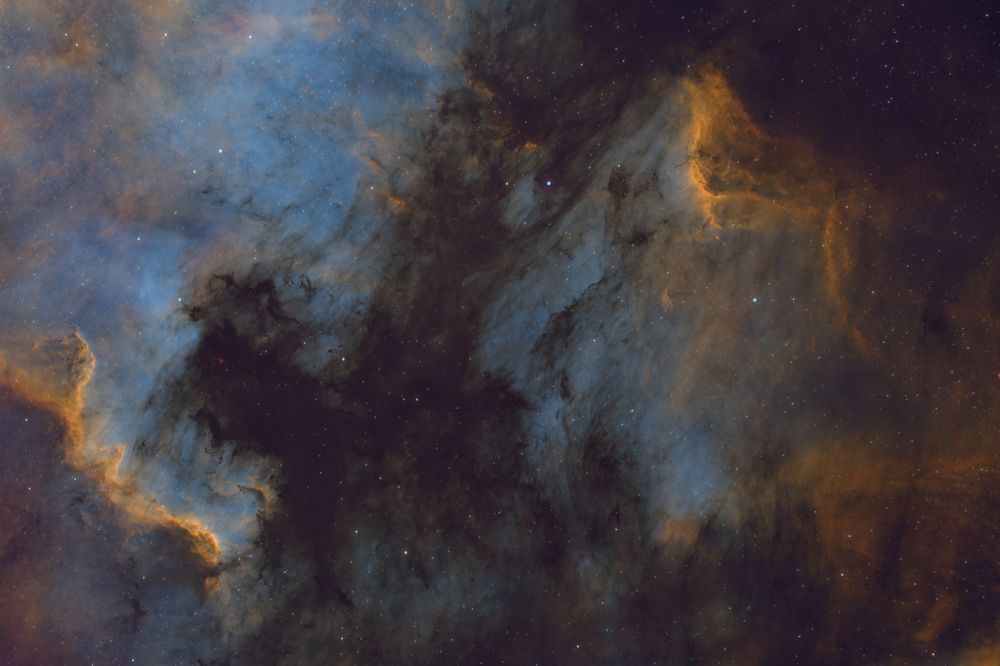
The "IC 5070 Pelican Nebula" photograph reveals a stunning star-forming region, approximately 30 light-years wide and located 1,800 light-years from Earth. Captured from my Bortle 8 backyard in Phoenix, this image showcases the dynamic interplay of hydrogen gas emitting light, a hallmark of emission nebulae. Over five nights, I meticulously gathered 175 subframes in Hydrogen-alpha, Oxygen III, and Sulfur II, allowing the vibrant colors and intricate details to emerge.
This nebula, often likened to a pelican due to its shape, is a testament to the ever-evolving nature of the cosmos. The ionization front, driven by the light from young, energetic stars, is gradually transforming the gas clouds, ensuring that this celestial formation will look different in millions of years. The thin dark dust cloud known as L935 separates it from the nearby North America Nebula, adding depth to the scene.
Imagine this photograph gracing your decor, inviting contemplation and sparking curiosity about the universe. Its rich colors and textures can serve as a focal point, drawing you into the mysteries of space.
Explore the beauty of the Pelican Nebula and consider how it might enhance your space. This piece is available in my online gallery, ready to bring a touch of the cosmos into your home.
NOTE:
The majority of photographs of nebulae are in a false color palette. False-color photographs of nebulae are essentially color (RGB) photographs whose color channels have been mapped to specific emission lines. In these images, each color can represent a specific element. In other words, a false-color image of a nebula tells us exactly what it’s made of. There are many emission lines, but the three most photographed by astronomers are hydrogen-alpha, oxygen-III, and sulfur-II. These emission lines are captured by using narrowband filters which only let through the light at very specific wavelengths, typically most of my photographs are taken with filters allowing a bandwidth of 3µm.
|
Element
|
Emission line
|
Wavelength
|
Color
|
|
Hydrogen
|
Hα
|
656.3 nm
|
Red
|
|
Oxygen
|
O-III
|
500.7 nm
|
Blue/Green
|
|
Sulfur
|
S-II
|
672.4 nm
|
Red
|
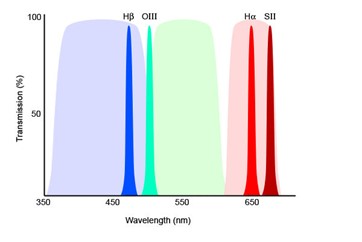
Mapping Hα, O-III and S-II to red, green and blue is problematic when two of them are red, one is blue/green, and none is pure blue. Astronomers deal with this by using false color — one or more of these elements is going to have to take a hit for the team and take on an unnatural hue. The Hubble palette assigns red to S-II, green to Hα, and blue to O-III: red is accurate, green and blue are false. This photograph uses the Hubble color palette, hence the golds and blues you find in the photograph.