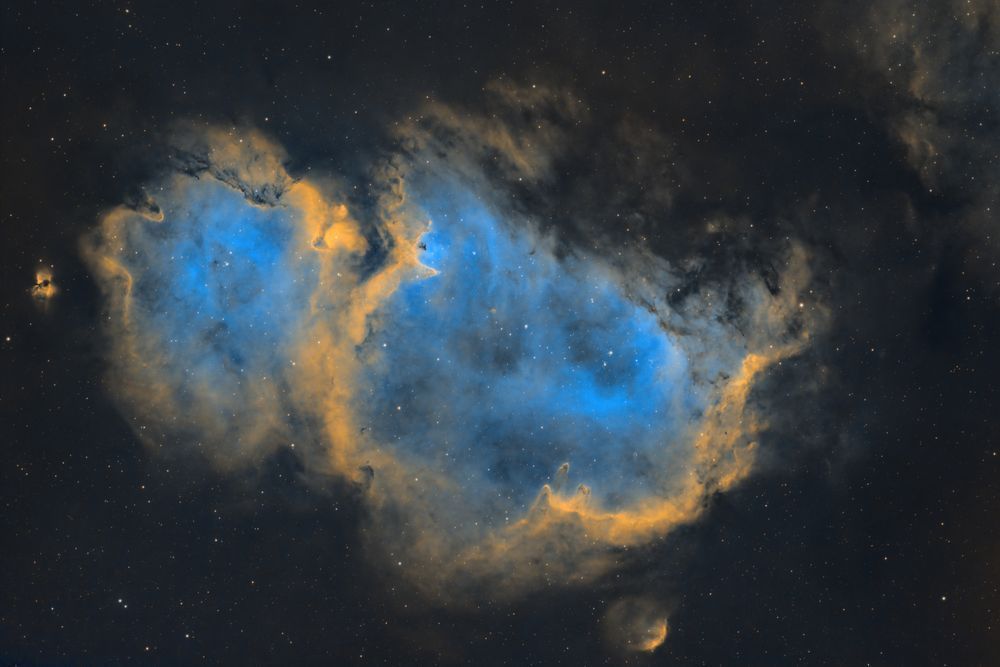
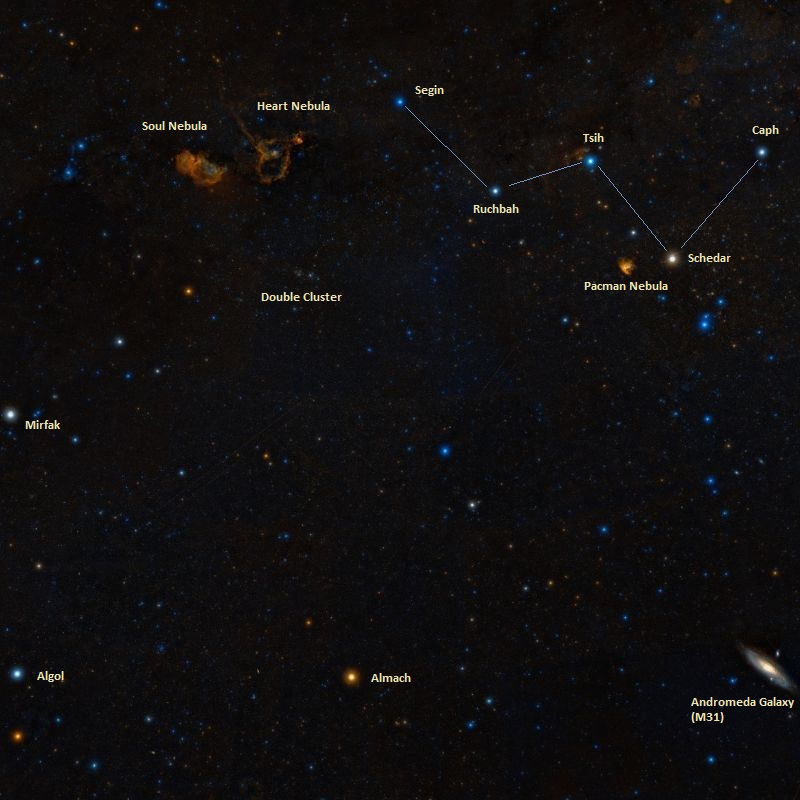
The majority of photographs of nebula are in a false color palette. False-color photographs of nebulae are essentially color (RGB) photographs whose color channels have been mapped to specific emission lines. In these images, each color can represent a specific element. In other words, a false-color image of a nebula tells us exactly what it’s made of. There are many emission lines, but the three most photographed by astronomers are hydrogen-alpha, oxygen-III and sulfur-II. These emission lines are captured by using narrowband filters which only let through the light at very specific wavelengths, typically most of my photographs are taken with filters allowing a bandwidth of 3µm.
|
Element
|
Emission line
|
Wavelength
|
Color
|
|
Hydrogen
|
Hα
|
656.3 nm
|
Red
|
|
Oxygen
|
O-III
|
500.7 nm
|
Blue/Green
|
|
Sulfur
|
S-II
|
672.4 nm
|
Red
|
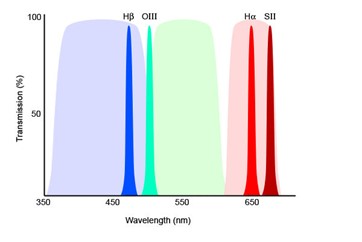
Mapping Hα, O-III and S-II to red, green and blue is problematic when two of them are red, one is blue/green, and none is pure blue. Astronomers deal with this by using false color — one or more of these elements is going to have to take a hit for the team and take on an unnatural hue. The Hubble palette assigns red to S-II, green to Hα, and blue to O-III: red is accurate, green and blue are false. This photograph uses the Hubble color palette, hence the golds and blues you find in the photograph.