Which size is right for your space?
- Living room (above sofa): 48x32
- Bedroom (above headboard): 36x24 or 48x32
- Dining room: 36x24 or 48x32, depending on wall size
- Home office or den: 30x20 or 36x24
- Large foyer or entryway: 48x32
- Hallway, bathroom, or gallery wall: 18x12 or 24x16
When in doubt, go bigger than you think. The art, including any frame, should fill about ⅔ the width of the furniture beneath it. Sizes listed are the photograph itself; framed paper prints, with a 2" mat and frame, are about 3–5" larger in each direction.
See it on your wall before you order
Use the buttons below the image:
- Wall Preview: upload a photo of your room and see this print on your wall in your chosen size and frame.
- Live Preview AR: on your phone or tablet, point your camera at your wall and see the print there in real time.
Framed prints arrive ready to hang
Framed paper prints are matted with a 2" white mat and protected by non-glare acrylic, so the image stays clear without reflections from windows or lights. Acrylic is lighter and safer to ship than glass, and every framed print arrives with hanging hardware already attached.
MetalPrints with a float mount or frame also arrive ready to hang.
Questions about size, material, or framing? See the FAQ or email me a photo of your wall, and I'll suggest a size and finish.
About this photograph
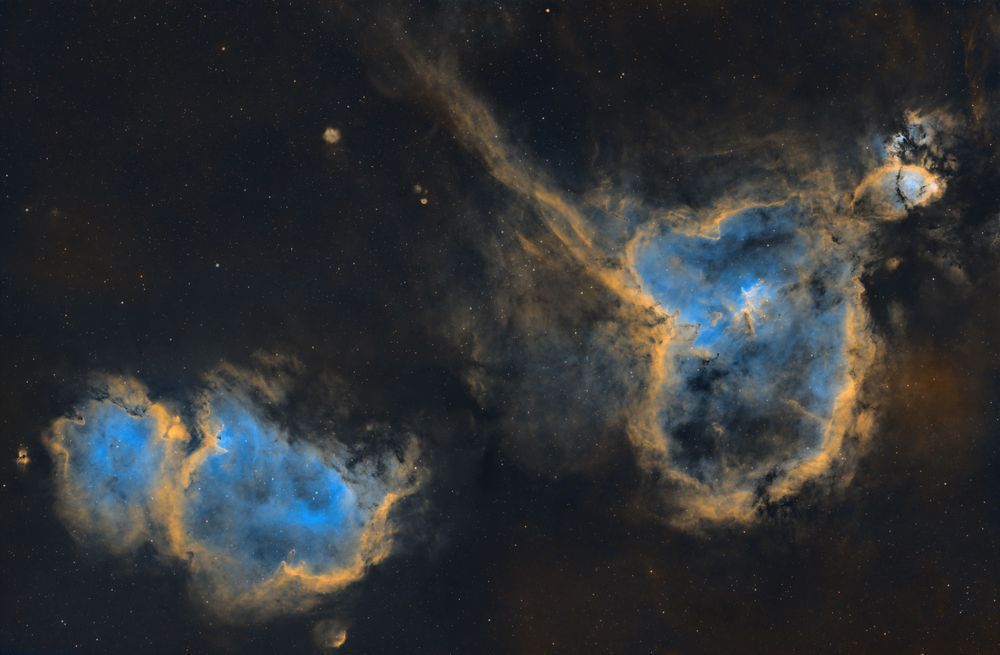
This photograph, titled "Heart and Soul Nebula Complex Mosaic," presents a stunning view of the Heart and Soul Nebulae, two vibrant regions in the Perseus Arm of the Milky Way. Captured over four weeks, this four-panel mosaic showcases the nebulae's striking red hues, a result of excited hydrogen gas illuminating the cosmos. The intricate details reveal a star-forming complex, home to several open clusters of young stars, including the notable IC 1805 and IC 1848.
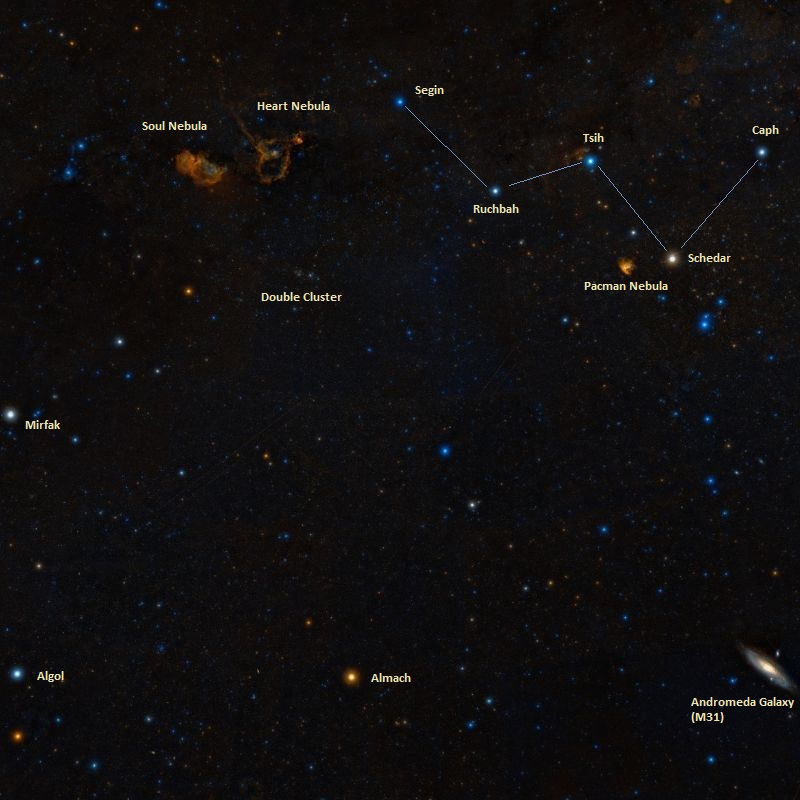
Utilizing the Hubble color palette, this piece transforms the celestial scene into a vivid tapestry of color and light. Each panel is composed of approximately 120 stacked images, meticulously captured from my backyard in Phoenix, Arizona, despite the challenges posed by urban light pollution. The result is a breathtaking representation of a region that is often elusive to the naked eye, making it a favorite among astrophotographers.
NOTE:
The majority of photographs of nebulae are in a false color palette. False-color photographs of nebulae are essentially color (RGB) photographs whose color channels have been mapped to specific emission lines. In these images, each color can represent a specific element. In other words, a false-color image of a nebula tells us exactly what it’s made of. There are many emission lines, but the three most photographed by astronomers are hydrogen-alpha, oxygen-III and sulfur-II. These emission lines are captured by using narrowband filters which only let through the light at very specific wavelengths, typically most of my photographs are taken with filters allowing a bandwidth of 3µm.
|
Element
|
Emission line
|
Wavelength
|
Color
|
|
Hydrogen
|
Hα
|
656.3 nm
|
Red
|
|
Oxygen
|
O-III
|
500.7 nm
|
Blue/Green
|
|
Sulfur
|
S-II
|
672.4 nm
|
Red
|
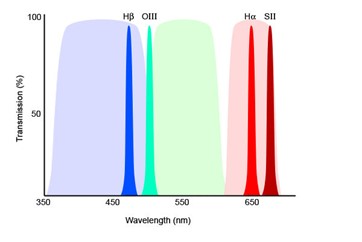
Mapping Hα, O-III and S-II to red, green and blue is problematic when two of them are red, one is blue/green, and none is pure blue. Astronomers deal with this by using false color — one or more of these elements is going to have to take a hit for the team and take on an unnatural hue. The Hubble palette assigns red to S-II, green to Hα, and blue to O-III: red is accurate, green and blue are false. This photograph uses the Hubble color palette, hence the golds and blues you find in the photograph.
I chose to render the photograph of the Heart And Soul Nebulae using SHO, otherwise known as the Hubble color palette. See below in the Full Description section for an explanation of SHO color palette.
This photograph is a four-panel mosaic I captured over four weeks. About 120 images were stacked per panel. I captured this in my Bortle 8 urban skies in my backyard in Phoenix, Arizona.