Which size is right for your space?
- Living room (above sofa): 48x32
- Bedroom (above headboard): 36x24 or 48x32
- Dining room: 36x24 or 48x32, depending on wall size
- Home office or den: 30x20 or 36x24
- Large foyer or entryway: 48x32
- Hallway, bathroom, or gallery wall: 18x12 or 24x16
When in doubt, go bigger than you think. The art, including any frame, should fill about ⅔ the width of the furniture beneath it. Sizes listed are the photograph itself; framed paper prints, with a 2" mat and frame, are about 3–5" larger in each direction.
See it on your wall before you order
Use the buttons below the image:
- Wall Preview: upload a photo of your room and see this print on your wall in your chosen size and frame.
- Live Preview AR: on your phone or tablet, point your camera at your wall and see the print there in real time.
Framed prints arrive ready to hang
Framed paper prints are matted with a 2" white mat and protected by non-glare acrylic, so the image stays clear without reflections from windows or lights. Acrylic is lighter and safer to ship than glass, and every framed print arrives with hanging hardware already attached.
MetalPrints with a float mount or frame also arrive ready to hang.
Questions about size, material, or framing? See the FAQ or email me a photo of your wall, and I'll suggest a size and finish.
About this photograph
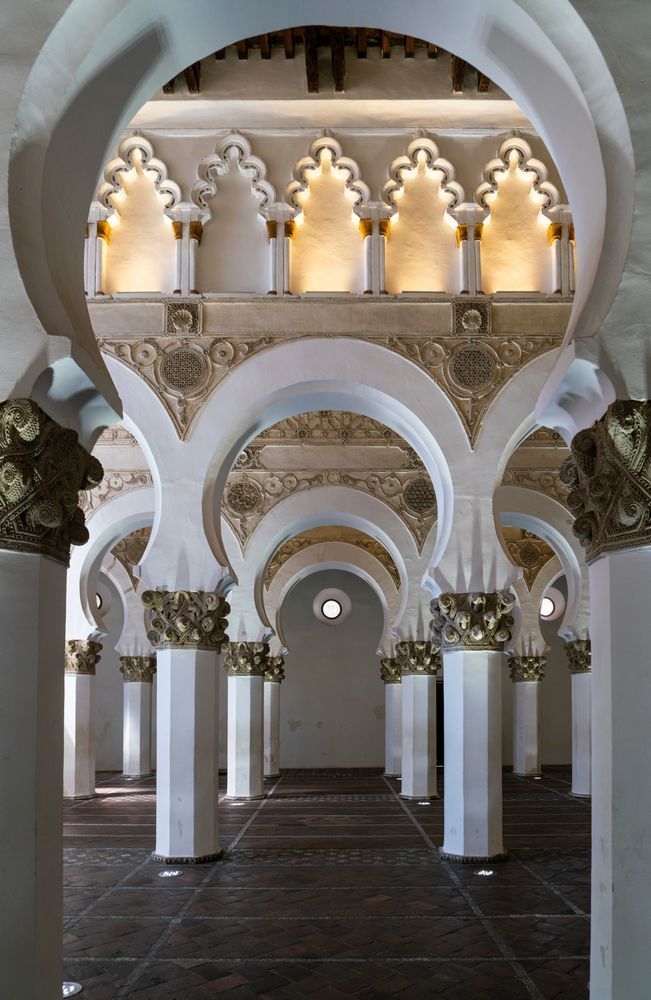
Santa María la Blanca is one of Toledo's hidden gems—a former synagogue turned church that showcases the Mudéjar style at its finest. This architectural tradition emerged when Muslim craftsmen worked under Christian rule, blending Islamic geometric patterns with European forms. The result is something you don't see anywhere else.
I was drawn to the way the horseshoe arches repeat along the nave, each supported by octagonal columns with elaborately carved capitals. The white plasterwork against those arches creates a rhythm that pulls your eye through the space. I waited for the natural light to come in at an angle that would emphasize the three-dimensional quality of the carved details.
What makes this space remarkable is its layered history—built as a synagogue in the 12th century, converted to a church in the 15th, and now preserved as a monument. You can see all of those influences in the architecture: the Islamic decorative vocabulary, the Christian spatial reorganization, the Jewish heritage in the building's bones.
The geometric patterns and play of light and shadow give this image a meditative quality that works particularly well in quiet spaces.