Which size is right for your space?
- Living room (above sofa): 48x32
- Bedroom (above headboard): 36x24 or 48x32
- Dining room: 36x24 or 48x32, depending on wall size
- Home office or den: 30x20 or 36x24
- Large foyer or entryway: 48x32
- Hallway, bathroom, or gallery wall: 18x12 or 24x16
When in doubt, go bigger than you think. The art, including any frame, should fill about ⅔ the width of the furniture beneath it. Sizes listed are the photograph itself; framed paper prints, with a 2" mat and frame, are about 3–5" larger in each direction.
See it on your wall before you order
Use the buttons below the image:
- Wall Preview: upload a photo of your room and see this print on your wall in your chosen size and frame.
- Live Preview AR: on your phone or tablet, point your camera at your wall and see the print there in real time.
Framed prints arrive ready to hang
Framed paper prints are matted with a 2" white mat and protected by non-glare acrylic, so the image stays clear without reflections from windows or lights. Acrylic is lighter and safer to ship than glass, and every framed print arrives with hanging hardware already attached.
MetalPrints with a float mount or frame also arrive ready to hang.
Questions about size, material, or framing? See the FAQ or email me a photo of your wall, and I'll suggest a size and finish.
About this photograph
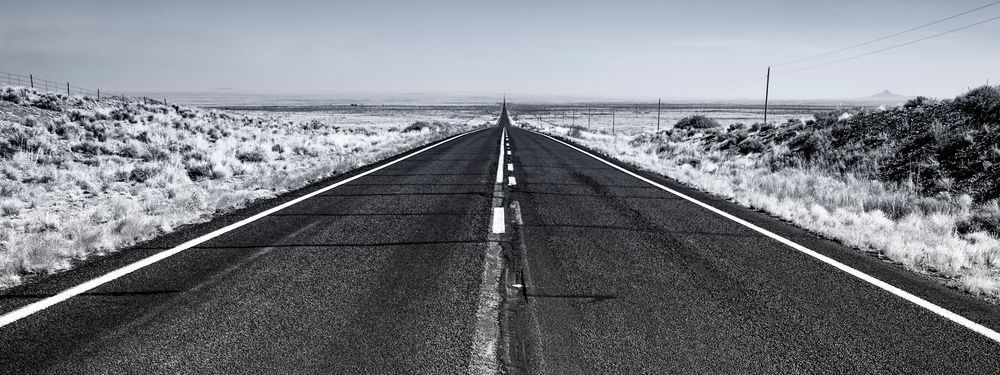
Open road photography—the classic vanishing point composition where highway stretches to the horizon—works particularly well in black and white. Removing color emphasizes the graphic elements: the road's center line creating a leading line, the pavement's texture, the interplay of light and shadow defining the road's surface and surrounding landscape.
Converting to monochrome strips away regional identifiers that color might provide—desert reds, prairie greens, mountain blues—creating a more universal representation. The road becomes less about specific place and more about the conceptual journey, the metaphorical path. The tonal range from bright pavement to darker surrounding landscape or sky defines depth and distance.
The challenge is managing exposure across the scene—bright road surface, darker surroundings, sky that could be overcast or clear—while maintaining detail throughout. The vanishing point composition relies on that tonal gradation to create the sense of infinite distance, the road disappearing into the horizon.
Monochrome treatment emphasizes graphic simplicity and universal journey metaphor in this classic open road composition.